





Sustainable Business: Purpose, Profit & Impact
What happens when you bring together people all trying to build a sustainable business that does good and still thrives?
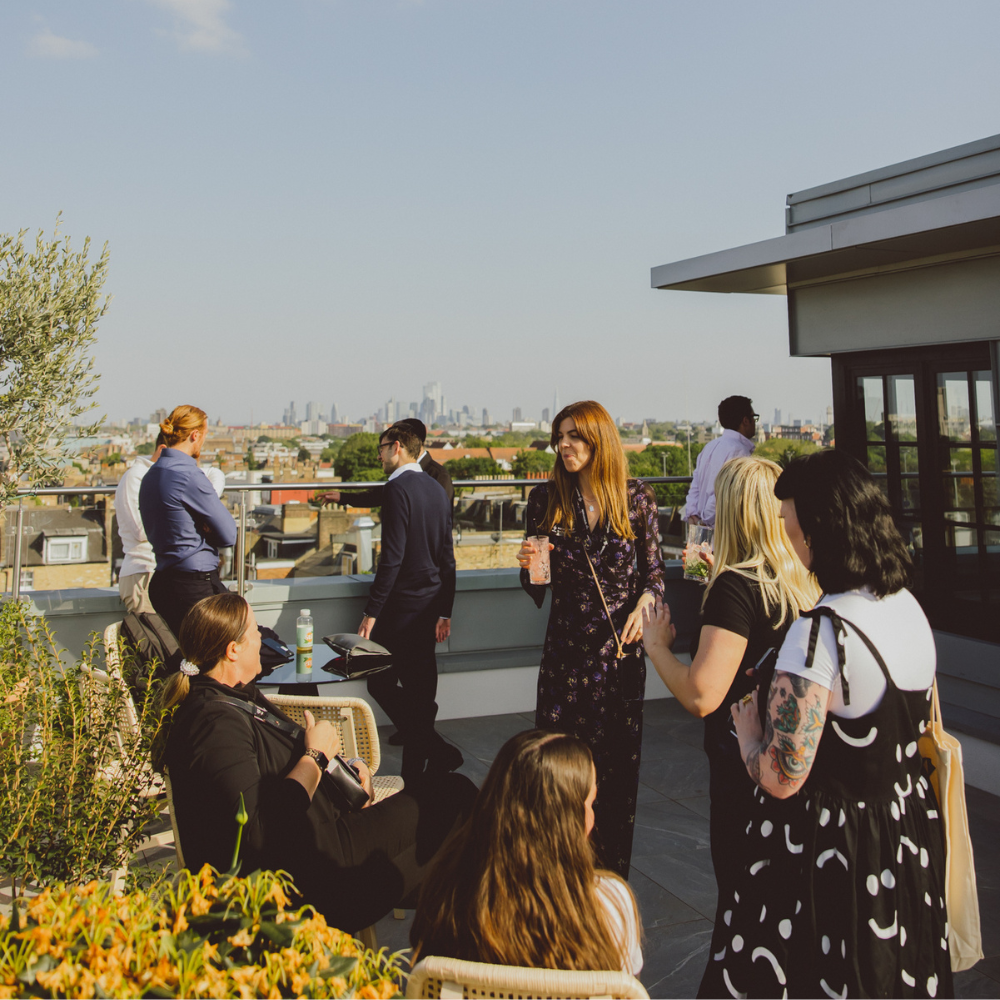
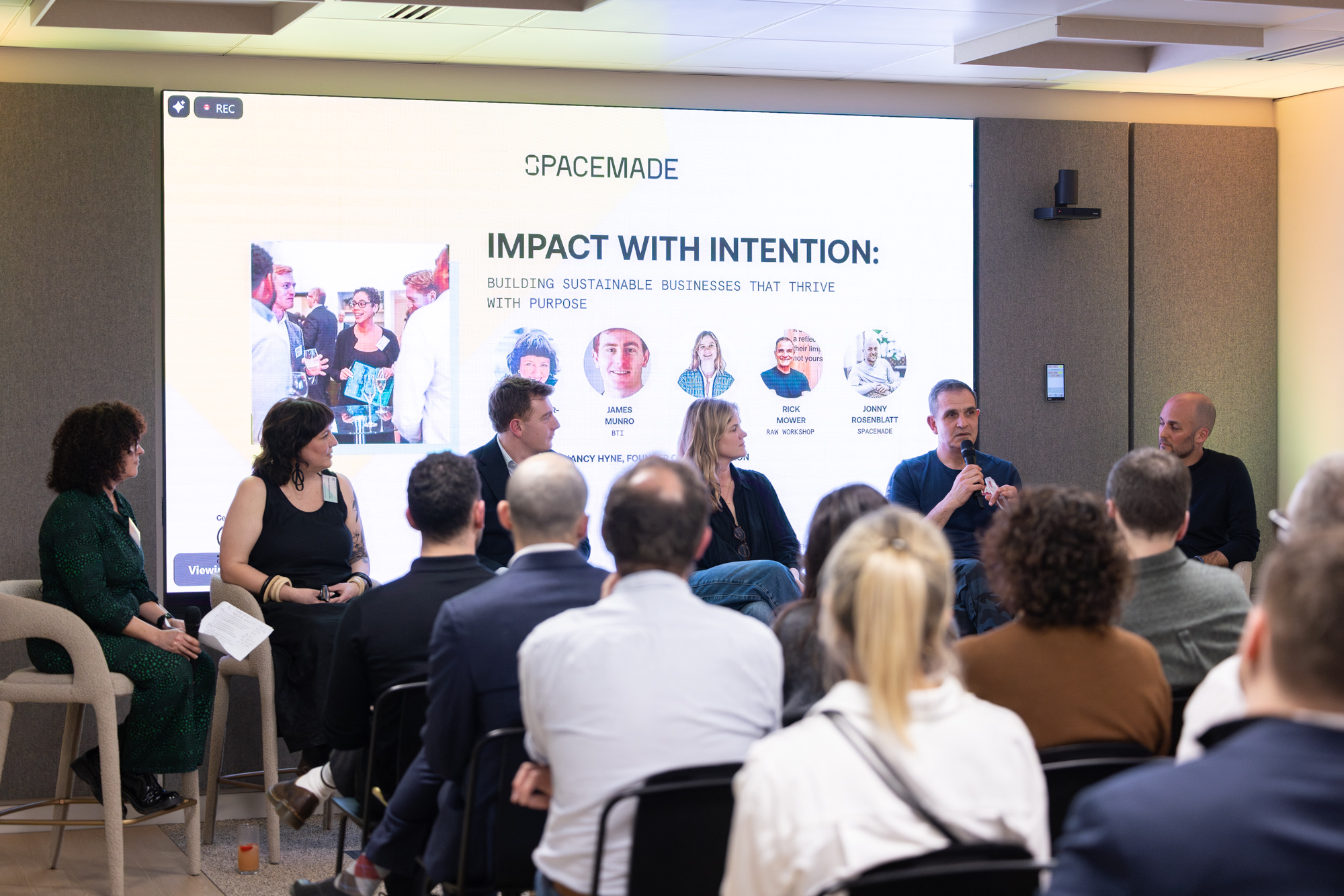
That question was the foundation of Impact with Intention — an evening built as an honest, practical conversation about sustainable business. Not the neatly packaged version you see in annual reports, but the real one, shaped by trade-offs, early mistakes, and the stubborn belief that it’s still worth doing anyway.
It also marked a moment for Spacemade, sitting alongside the launch and reflection of our latest impact report — a chance to bring our wider commitment to sustainability into a live conversation with founders facing the same challenges in very different ways.
Bringing together five founders whose businesses sit at the intersection of purpose and commerce — Callie Tedder-Hares of Spared, Sophie Salisbury of Reia, Rick Mower of RAW Workshop, James Munro of BTI, and Spacemade’s CEO Jonny Rosenblatt — the conversation was guided by sustainability consultant Nancy Hyne of True Horizon.
What started as an idea back in July took months to bring to life, and only came together through a huge amount of care and effort from everyone involved. Personally, being trusted to lead it has meant a great deal — building a panel of people I genuinely admire, whose work I find endlessly interesting to listen to and learn from, and bringing them into conversation with one another in a space we’re proud of is not something I take lightly.
More than a single evening, it represents something bigger. Impact with Intention is a step towards Spacemade becoming not only a place for meaningful connection, but a platform for creating impact, with intention. And that feels like exactly where we should be heading.

Impact Isn’t One Thing
One of the first things to emerge was how differently each business defines and measures impact, and how that’s not a problem, but a feature.
For Jonny, impact at Spacemade is inseparable from the built environment itself. Real estate accounts for roughly 40% of carbon emissions, and yet the industry has long congratulated itself for putting recycling bins in breakout spaces. Spacemade’s B Corp certification pushed the business to think beyond that, not just about the spaces themselves, but about the entire ecosystem around them: the tea supplier, the coffee roaster, the caterer, and the charities each site team chooses to support at a local level.
“We’re not here to just sell desks,” Jonny said. “It’s about bringing people into an environment that encourages them to connect with other people.”
For Rick Mower, impact has always been about people first< specifically, people the professional world tends to overlook. RAW Workshop employs individuals with backgrounds in addiction, homelessness, and the justice system, manufacturing commercial furniture for major brands. The sustainability story is partly about materials, but mostly about what happens when you see resilience instead of disadvantage.
“Statistically, the people who survive that stuff are rare,” Rick said. “Once you see it through that lens, if you give them a place where they can really thrive, magic happens.”
Callie Tedder-Hares brought a different angle entirely: the beauty of waste. Spared takes construction and manufacturing waste and transforms it into furniture and products. The measure of impact, for Callie, is keeping materials out of landfill, but also proving to clients that their waste has value they hadn’t considered. After four years of investing profits from their design agency back into the waste-focused side of the business, 85% of Spared’s work now comes from waste streams, up from 30% just two years ago.

The Honest Tension Between Purpose and Profit
The conversation didn’t shy away from the harder reality: that purpose without profit isn’t sustainable in itself.
Sophie Salisbury of Reia, a refillable personal care brand, described what it means to compete against legacy players in a market where customers have been conditioned to expect a certain price point. Reia pre-prints a Royal Mail returns label on the back of every refill pouch. Every investor they spoke to flagged the cost. But for Sophie, that’s precisely the point — demonstrating that a small brand can take responsibility for the full lifecycle of its product, and building toward the moment that approach travels up the supply chain.
“There are other decisions in our business where we might have to prioritise profit,” she said. “But those red lines are ones we won’t cross.”
James Munro of BTI, which manufactures made-to-order clothing for luxury fashion brands, talked about the educational work that comes with challenging a wasteful industry model. Made-to-order production means higher prices and longer lead times — but no dead stock, better cash flow, and a growing base of consumer trust. Over four years, BTI has helped launch around 120 made-to-order brands worldwide.
The common thread across all five panellists wasn’t that profit and purpose are always easy to balance. It’s that the businesses which have found ways to make them reinforce each other — rather than treating impact as a bolt-on — are the ones building something that lasts.
Embedding It, Not Displaying It
Perhaps the most practically useful section of the evening explored how impact actually gets embedded into a business, as opposed to being attached to it.
Spacemade’s approach has been shaped by its B Corp journey: ensuring that sustainability filters through supplier relationships, hiring decisions, and the community programmes each site runs. Rather than a central charity chosen by head office, every Spacemade location partners with two local charities, chosen by the site team. Over 500 events take place across the network each year. The logic is straightforward — the people on the ground know which causes matter in their community.
For Reia, it starts with a north star metric: how many plastic bottles have been removed from circulation. That number sits at the top of every investor update. It’s checked monthly. It keeps the team oriented when other priorities crowd in.
For Spared, it’s about making the connection between waste and value visible — and proving that you don’t need to sacrifice design quality to work with what already exists.
The People Piece
Sustainability, the panel agreed, isn’t only about the environment. It’s about whether the structures a business builds, hiring, culture, and physical space, genuinely allow people to thrive.
Jonny spoke about the flex workspace sector as an entry point into an industry, commercial real estate, that has historically been slow to reflect the full range of people who work within it. The diversity across Spacemade’s team isn’t the result of targets, he said. It’s the result of hiring for values over credentials and building spaces that attract a broad community.
Rick put it simply: the younger generation isn’t making a political statement by expecting businesses to behave responsibly. They just won’t work for companies that don’t. That’s not a challenge, it’s a commercial reality, and an opportunity.

Why This Conversation Matters
What made Impact with Intention different from a standard sustainability panel was the refusal to make it abstract. These were founders who had made expensive decisions, turned down the wrong investors, scaled too fast and learned from it, and built businesses around the conviction that doing things properly and doing things profitably are not, in the end, opposites.
The evening raised funds for King’s College Hospital Charity, every ticket a direct donation, matched by Spacemade, turning the conversation itself into impact.
It was the first event of what will now be an annual series. The intention is to keep it practical, keep it honest, and keep bringing the right people into the room.
Because as the evening showed, that’s where the real impact starts.
Our Partners
The evening wouldn’t have been what it was without the partners who brought it to life, and who are already part of the Spacemade ecosystem. Volcano Coffee Works, Bird & Blend Tea Co., Humdingers Catering, and Flawsome! Drinks didn’t just show up to fill a table. Each was chosen because their values are genuinely aligned with what Spacemade stands for: proof, as the panel itself discussed, that supply chain choices are culture choices. Having partners who already understood that made the evening feel coherent from the first drink to the last conversation.
Written by Michele, Project & Sustainability Manager at Spacemade